
Rahul (راهول)
Founder & CEO
$1B+ in AI-led value delivered across enterprise engagements spanning AI strategy, commercial optimization, and oil & gas supply chain. Leads client relationships and company direction.
AI-led yield optimization
Every day your hydrocracker runs, a decision gets made with only part of the picture, and the margin from the rest of it disappears quietly.
Middle distillate output from a real, anonymised unit across a full catalyst run: 881 operating days of history.
The band is what this unit typically makes at each point in the catalyst's life. The dashed line is its best demonstrated weeks: not a design figure, something it has already done.
Valued at each month's middle-distillate crack over unconverted oil, the gap to its own best weeks comes to $53.5M over the run. About $22M a year.1
Operations, logistics and commercial each optimize their own piece. None of them sees the whole one.
Decisions made in isolation. Margin left on the table.
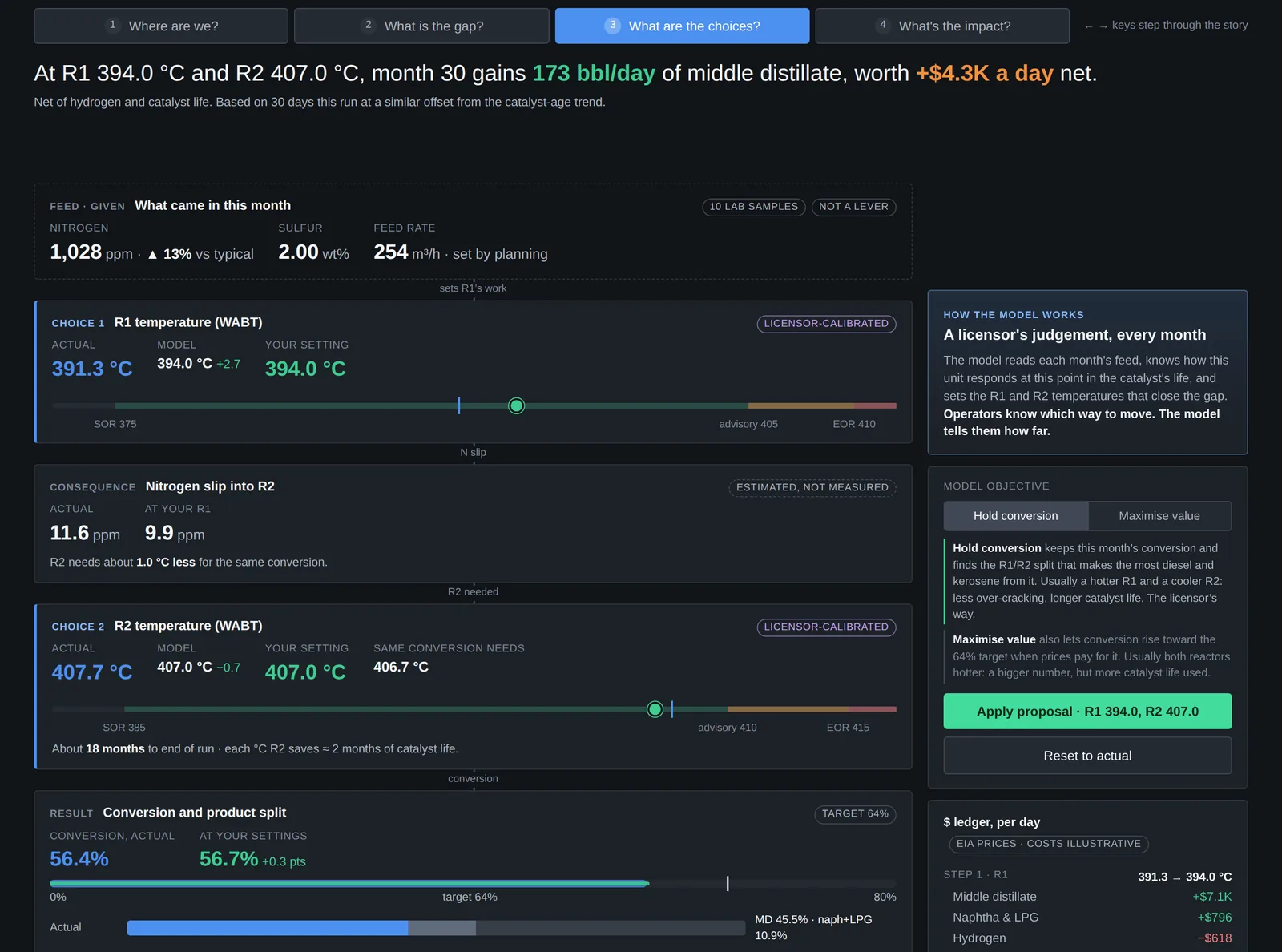
R1 strips nitrogen out of the feed; R2 does the cracking. Run R1 hotter and less nitrogen slips through, so R2 needs less heat for the same conversion. Move R1 and see what happens.
Operators know which way to move. The model tells them how far.
Each month it reads the feed, knows how this unit responds at this point in the catalyst's life, and proposes R1 and R2 together. Here: R1 up 2.7 °C and R2 down 0.7 °C, holding conversion. Your engineers accept, defer or reject.
What your engineer sees: the option, its predicted yield impact, and how confident the model is. What happens on approval: the change is logged, and the outcome is tracked against the prediction.
Before anything else.
We learn your unit, your data, your constraints.
A working model, on your data, reviewed by your team.
We connect what you already have (historian data, planning models, contracts, shipping constraints) into one model of your unit. It predicts the yield impact of a decision before it's made, and ranks the options. Your engineers review every recommendation before anything changes. Nothing acts on its own.
Read-only access. No changes to your infrastructure. Every recommendation reviewed by your engineers before anything changes.
“They tied together data sources that had never talked to each other before, and gave us real-time visibility into our trading decisions and the margin impact behind them. That turned into a strategic advantage, not just an operational one.”
“What stood out was the review step — every recommendation came with the reasoning, and our people made the call, not the model. And they moved fast: we had something real in front of us in weeks, not a quarter of scoping meetings.”
Shared with permission. Names are withheld to respect client confidentiality.
$1B+ in AI-led value delivered across enterprise engagements spanning AI strategy, commercial optimization, and oil & gas supply chain. Leads client relationships and company direction.

35 years heading refining operations at state-owned South Asian refineries. Expert in hydrocracking chemistry, catalysts, and yield optimization. Has run hydrocracker units at scale and knows every lever from the inside.

Frontier AI embedded as Hydrocracker.ai's core reasoning layer, holding chemistry, economics, and live market data in one model. Runs in advisory mode: every output is reviewed by our team before anything changes.
A 3–4 week POC costs far less than the margin you're already losing.